The technology behind the everyday
Tiny chips, smoother connections: from coherent optics to AI
A family video call, a cloud photo album and an AI assistant all rely on a less visible world of optical components. Some give light a message. Others simply make sure there is enough good light to begin with.
When your video call has better things to do than freeze
Nobody joins a video call hoping to admire an optical modulator. We want to see a familiar face and hear the end of a sentence. Behind that ordinary wish sits a network carrying many people’s conversations, photos and applications at once.
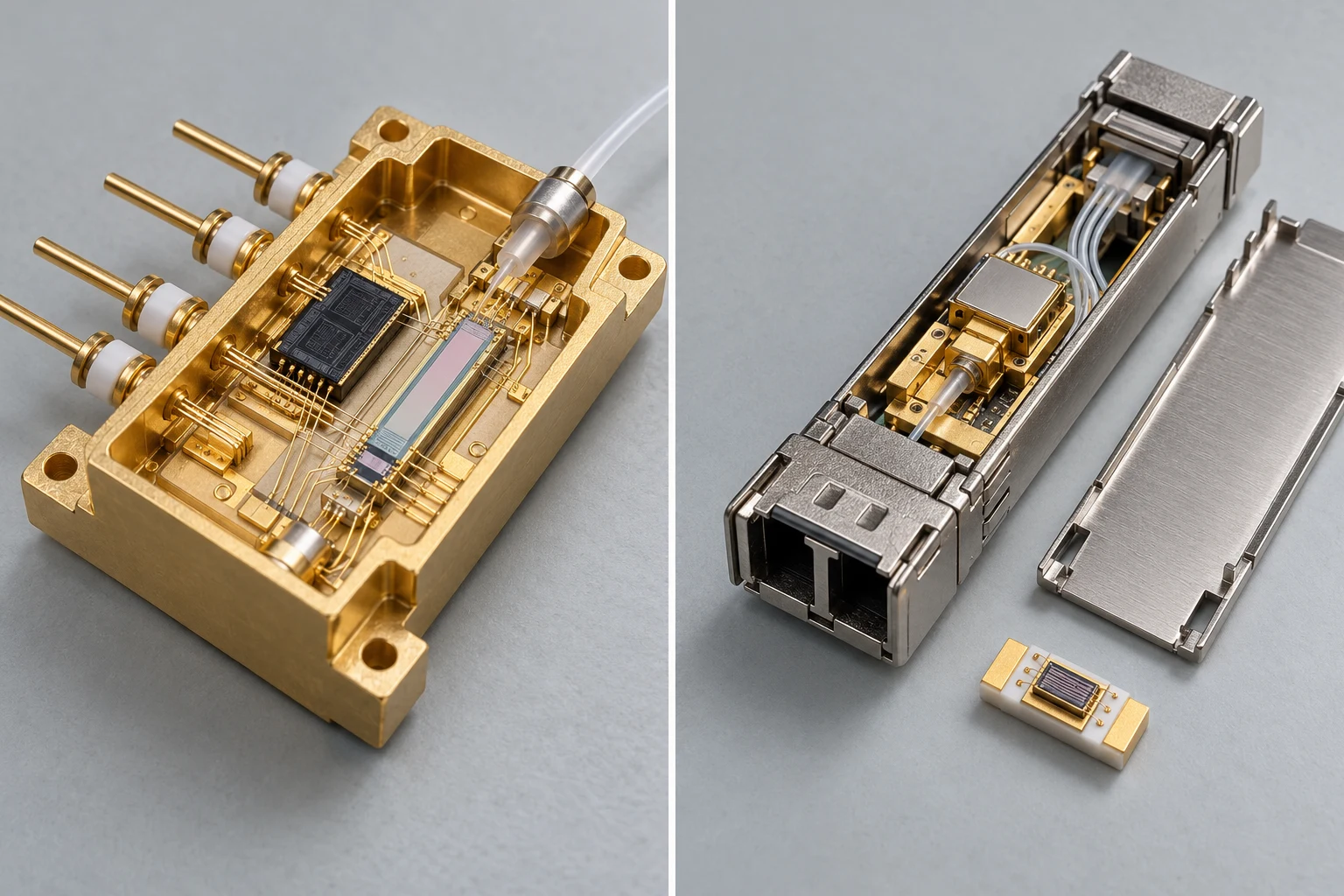
A coherent driver modulator, or CDM, combines high-speed electrical driving with optical modulation. In a coherent transmitter, information is encoded in properties of light such as amplitude and phase, using both polarizations. Together with lasers, receivers and digital signal processing, these components help optical networks carry large amounts of information.
A small but useful correction to “130G”
130 GBaud describes approximately 130 billion symbols per second. It is not the same as 130 gigabits per second: the information carried by each symbol, polarization and coding overhead also matter.
Lumentum publicly describes a 130+ GBaud InP-based Smart TROSA capable of supporting up to 800 Gb/s on one wavelength. A TROSA is a transmitter-receiver optical subassembly, not simply a CDM. Separately, Nokia describes coherent optical networking solutions for AI-era connectivity, combining digital signal processors with optical front ends. These are useful public examples of progress at component and system levels.
The sources linked below do not establish a specific Nokia product called “130G CDM” or a particular Nokia–Lumentum supply arrangement. This note makes neither claim.
What gets easier for us?
More capable optical transport can help networks accommodate growing demand for cloud services, shared media and communication between data centres. Think of it as making room on a shared road rather than promising that one new component will fix your home Wi-Fi. The server, access connection, network congestion and application still influence the experience.
The enjoyable part is how small the enabling hardware can be compared with the human activity it supports. A component you will never see helps carry a conversation you would not want to miss.
The DFB laser: the light source with a steady job
A distributed-feedback laser uses a built-in periodic structure to favour a particular optical mode. In an external-light-source architecture, a laser can provide continuous-wave light while another device adds the data. The laser supplies the carrier; the modulator gives it something to say.
Not every DFB chip is suitable for this role. Optical power, efficiency, wavelength stability, noise, coupling and reliability have to match the system. Lumentum has published work on high-power continuous-wave DFB lasers for co-packaged optics, providing a public connection between familiar InP laser technology and this newer application.
From a tiny laser chip to an ELSFP module
ELSFP means external laser source form factor pluggable. The chip is one building block; the module adds the packaging, optical interfaces, electrical support and monitoring required by its design. It is a light-source module, not automatically a complete data transceiver.
Lumentum describes its InP ultra-high-power laser platform being integrated into ELSFP modules for silicon-photonics optical engines. Keeping the laser source outside the hot compute or switching package can help with thermal separation and service access. The realised benefit depends on the complete architecture, including optical distribution losses and cooling.
Why CPO makes this interesting for AI
Co-packaged optics brings optical engines close to high-bandwidth switching electronics. External laser sources can feed those engines without requiring the laser itself to sit beside the hottest chip. Coherent transport and CPO occupy different parts of the connectivity story; they should not be treated as the same link or product.
For AI, better connections can reduce communication constraints when the workload is limited by moving data. They do not make every model faster, improve its reasoning automatically or guarantee cheaper services. The playful way to picture the arrangement is a busy kitchen: the processors do the cooking, optical links move the orders, and the laser keeps the lights on for the optical part of the operation.
The public Lumentum connection
Lumentum’s published coherent components and external laser-source technologies illustrate two complementary jobs: encoding information for optical transport and supplying light for optical engines. The thread is photonics engineering, from the semiconductor device to a usable module. No personal employment history, customer-specific design, process recipe or unpublished performance information is used here.
Explore the public sources
- Nokia: coherent optical solutions for AI-era networks
- Lumentum: 130+ GBaud integrated coherent TROSA
- Lumentum: coherent driver-modulator example
- Lumentum: UHP laser sources and ELSFP integration
- Lumentum: published high-power CW DFB laser research
Independent educational commentary based on public sources. Manufacturer claims are attributed; no affiliation or endorsement is implied. Illustrations communicate general concepts rather than product specifications.