Photonics & Optical Infrastructure Insights
DFB Versus EML Lasers: Manufacturing and Supply Chain Implications for 800G and 1.6T Optics
Photonics Frontier Advisory · Published 18 October 2026 · Technical perspective
Understand the different roles of DFB light sources, EMLs and external modulators when evaluating optical supply chains.
Start with the modulation function
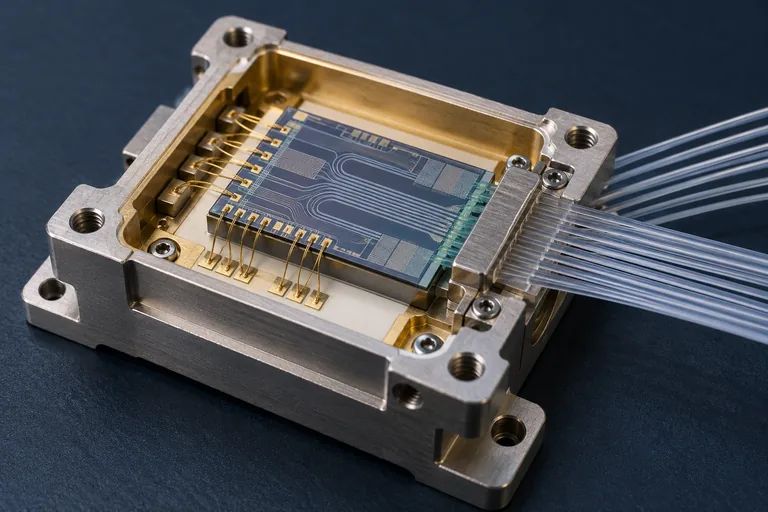
DFB describes a distributed-feedback laser structure. EML describes an electro-absorption modulated laser, which combines a laser section with an electro-absorption modulator. The labels are not mutually exclusive: an EML can contain a DFB laser section. Comparing DFB and EML as if they were simply competing bandwidth grades hides the actual architecture. First identify how the data is impressed on the light, then identify the laser, modulator, driver and package required to do it.
Two useful architectural paths
In an EML path, the electro-absorption section performs modulation on the laser device. In a continuous-wave-laser-plus-silicon-photonics path, the laser supplies steady light and a separate optical modulator encodes the data. Silicon photonics does not make the light source requirement disappear. Direct modulation of a laser is another category and should not be confused with either route. These distinctions affect where device performance, integration and qualification risks accumulate.
Aggregate bandwidth is not laser output power
A module rate combines multiple channels or lanes, subject to the actual interface specification. An arithmetic example of eight lanes at 200 Gb/s produces 1.6 Tb/s of aggregate nominal lane rate; it is not a universal description of every 1.6T product or its payload rate. Nor does doubling aggregate bandwidth necessarily double optical power from each laser. Reach, receiver sensitivity, modulation loss, splitting, channel count and operating margin determine the optical budget. Avoid deriving wafer demand from a bandwidth label alone.
Manufacturing exposure moves with the architecture
An EML must deliver suitable laser and electro-absorption-modulator behaviour, including their integration and high-speed interfaces. A CW route changes the requirements placed on the laser and shifts modulation demands to a separate engine. The source may need to meet demanding power, noise, efficiency and reliability objectives. Neither route is automatically easy to manufacture. A supplier comparison should examine the required device specification, the qualified process and the downstream assembly and test capacity for the intended application.
Count qualified devices, not generic InP capacity
Not every InP production line can make every device with the required performance and economics. Process compatibility, equipment capability, epitaxial structures, metrology and customer qualification can constrain substitution. Even within one architecture, different power or speed requirements may alter test times and yield distributions. The useful commercial question is how many customer-qualified units of the relevant specification can ship, not whether a supplier owns an InP fab or has announced additional wafer starts.
Ask questions that expose the assumptions
For a supplier thesis, document the module architecture, lane rate, optical reach, number of sources, allocation of modulation and the qualified device specification. Then map each to suppliers, packaging partners and test resources. Lumentum’s public product material describes both EML and CW offerings, illustrating why a company can participate in more than one route. Portfolio participation alone does not establish market share or the profitability of either route. Those conclusions require separate evidence.
Questions for your next review
- What evidence supports the conclusion, and what remains an assumption?
- Which qualification or manufacturing gate could change the commercial outcome?
- What additional records, tests or partner commitments would resolve the uncertainty?
Selected technical references
Public technical context reviewed for this article. Supplier material describes that supplier’s architecture; it is not independent proof of market adoption. The assessment framework above is original advisory analysis.
General technical analysis; no confidential employer or client information is used. No investment recommendation or guaranteed outcome is provided.
Related service: Co-Packaged Optics & AI Infrastructure Advisory