Ideas in photonic computing
Can light do the computing too?
Optical connections and optical computation solve different problems. Here is why that distinction matters.
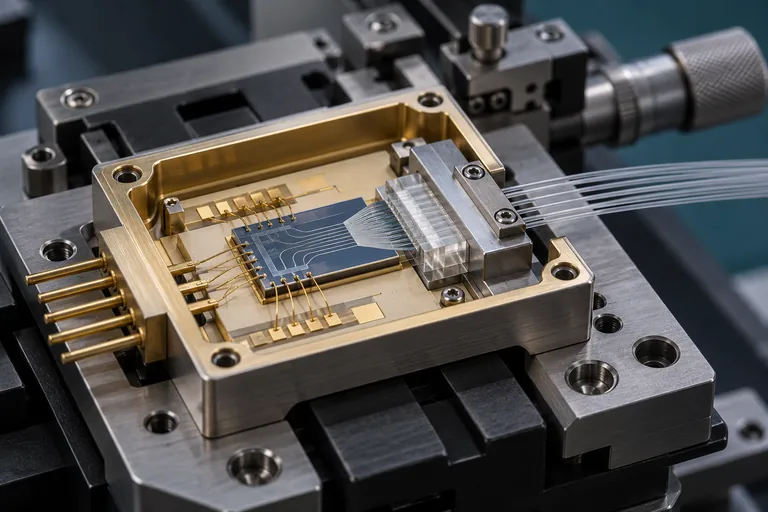
Using light to carry data is one idea. Using it to transform data is another. Photonic computing asks whether optical devices can perform useful parts of a calculation, rather than simply connect the electronic processors that perform it.
Why matrix operations attract attention
Many AI workloads contain repeated linear algebra. Optical interference and controlled transmission can represent weighted combinations of signals, making matrix operations an attractive research direction. A published photonic tensor-core experiment demonstrated parallel convolutional processing using integrated optical components and phase-change material memory.
That result is interesting because it shows a specific operation implemented in hardware. It does not establish that a complete AI application will be faster or more efficient than its electronic counterpart.
The calculation around the calculation
A useful computer needs more than its central mathematical operation. Inputs must be encoded, outputs measured, weights prepared and errors controlled. Depending on the architecture, electronics may still handle storage, scheduling, nonlinear functions and conversion.
Precision matters too. Optical signals are affected by noise and device variation. Some applications tolerate approximate arithmetic; others require tighter numerical accuracy. The right comparison therefore uses the same task, an explicit accuracy target and the energy and time needed for the entire computation.
A hybrid future is an interesting possibility
It is tempting to imagine an all-optical replacement for a GPU. A more useful thought experiment is a specialised optical accelerator working with electronics. Which operation would it accelerate? How often could it reuse programmed weights? Would moving information into and out of the optical hardware consume its advantage?
These are open engineering questions, not reasons to dismiss the idea. They make photonic computing a rewarding subject to follow: a meeting point between elegant physics and the practical discipline of building a useful machine.
Further reading
An independent educational note based on public sources. Interpretations and questions here are editorial perspectives; linked product descriptions are the suppliers’ own accounts.