AI infrastructure
Why AI needs better connections, not just faster chips
A look at the quieter role of photonics: moving information between the machines doing the computing.
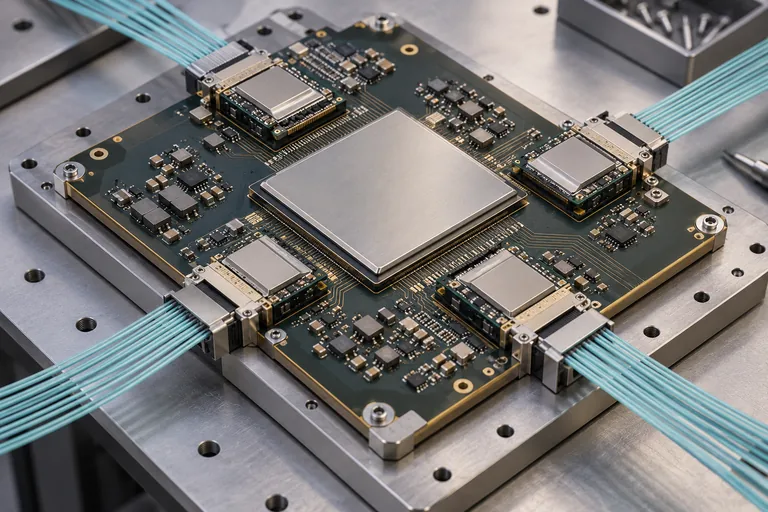
AI is often pictured as a collection of powerful processors. The connections between those processors deserve just as much curiosity. A chip can calculate quickly and still spend valuable time waiting for information from somewhere else.
The interesting problem between the chips
Training and running large models involves moving data between processors, memory and networked systems. The balance varies with the workload: some jobs are limited by arithmetic, others by memory access or communication. Adding more compute does not automatically remove those other limits.
Optical links carry information using light. Their appeal is strongest where electrical connections face difficult trade-offs between reach, bandwidth and energy. That does not mean every short wire should become a fibre. Electrical links remain useful, and converting between electrical and optical signals introduces its own overhead.
Moving optics closer
Two developments are worth distinguishing. Co-packaged optics brings optical engines close to a networking chip. Optical I/O explores light-based connections closer to compute packages. NVIDIA presents silicon-photonics networking products, while Intel has demonstrated an optical I/O chiplet operating alongside a CPU. These are examples of related approaches, rather than evidence that every AI system will adopt the same architecture.
What would make adoption convincing?
The fascinating question is the result across the system. Does the connection save enough energy after laser power and conversion are counted? Can it be manufactured, tested and serviced? Does the workload actually benefit from the extra communication capacity?
For an enthusiast following this field, those questions are more revealing than a headline bandwidth number. Light can make the journey between chips more practical; the rest of the machine still determines how useful that journey is.
Further reading
An independent educational note based on public sources. Interpretations and questions here are editorial perspectives; linked product descriptions are the suppliers’ own accounts.